
Introduction
A CAD library is a structured collection of reusable digital design assets used within computer-aided design environments. In engineering workflows, CAD libraries improve design efficiency, standardization, and data consistency by allowing teams to reuse validated components instead of recreating them for every project.
More specifically, a CAD component library contains standardized parts, symbols, and assemblies that can be inserted directly into CAD models and drawings. These libraries are widely used in mechanical design, electrical design, plant engineering, and product development, where accuracy, repeatability, and configuration control are critical.
What Is a CAD Library?
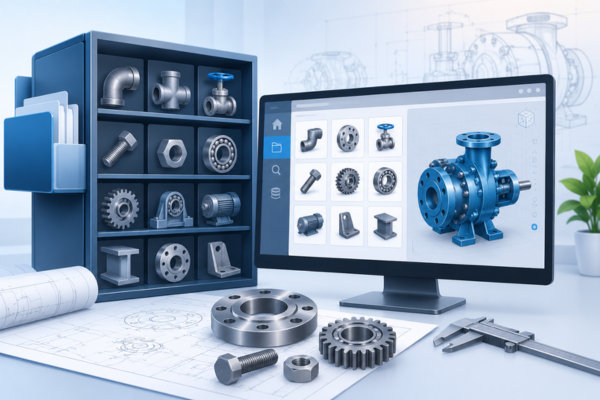
A CAD library is a centralized collection of predefined design objects used in CAD software. These objects may include:
- 2D drafting symbols
- 3D parametric models
- Standard parts
- Configurable assemblies
- Drawing templates
- Blocks, cells, and families
- Manufacturer-certified components
In technical terms, a CAD library serves as a controlled source of geometry and engineering data. Rather than storing only visual models, a well-developed library also contains metadata such as material definitions, dimensional parameters, tolerances, connection points, classification codes, and revision status.
This makes the CAD library not only a design resource, but also a data management layer that supports downstream engineering, manufacturing, and procurement processes.
What Is a CAD Component Library?
A CAD component library is a specialized subset of a CAD library focused on reusable engineering components. These components are typically modeled once, validated, and then deployed across multiple designs.
Examples of components commonly stored in a CAD component library include:
- Bolts, nuts, washers, and other fasteners
- Bearings, shafts, seals, and couplings
- Valves, flanges, fittings, and pipe supports
- Electrical connectors, terminals, relays, and switches
- Sensors, actuators, and control devices
- Housing, brackets, and enclosures
- OEM or supplier-specific parts
A technical CAD component library often includes both geometry and non-geometric attributes. For example, a valve model may contain nominal diameter, pressure class, end connection type, material grade, mass, manufacturer reference, and operating limits. This allows the component to function as an engineering object rather than only a drawing element.
Why CAD Component Libraries Matter in Engineering
CAD component libraries are important because they improve both design execution and engineering data quality.
- Design Reuse and Engineering Efficiency – Reusable CAD components reduce repetitive modeling work. Engineers can insert approved parts into assemblies without rebuilding geometry, shortening design cycles and improving productivity.
- Standardization Across Projects – A controlled CAD library ensures that teams use the same approved components, naming conventions, and technical definitions. This is especially important in large organizations where multiple engineers work across shared product lines or plant systems.
- Improved Model Accuracy – Validated components reduce the risk of incorrect dimensions, incompatible interfaces, or missing technical specifications. Standardized library objects also improve drawing consistency and assembly reliability.
- Better Integration with Enterprise Systems – When CAD components include structured metadata, they can be linked to PLM, PDM, ERP, and procurement systems. This supports part traceability, bill of materials accuracy, sourcing alignment, and lifecycle management.
- Stronger Configuration and Revision Control – Engineering components often change over time due to design updates, supplier changes, or compliance requirements. A managed CAD component library helps control revisions and prevents obsolete parts from being reused.
Key Technical Elements of a CAD Component Library
A high-quality CAD component library should include more than 3D geometry. At a technical level, each component should contain structured engineering information such as:
- Component name and standardized classification
- CAD model format and software compatibility
- Parametric dimensions and constraints
- Material specification
- Mass or physical properties
- Connection or interface definitions
- Part number and manufacturer reference
- Revision level and approval status
- Tolerance or performance data
- Associated documentation, such as datasheets or installation instructions
For configurable parts, the library may also include design rules, family tables, or parameter-driven variants. This is particularly useful for components such as pipe fittings, enclosures, or modular assemblies that exist in multiple sizes and configurations.
Best Practices for Building and Managing a CAD Component Library
To maintain technical quality and long-term usability, organizations should apply clear governance rules.
- Standardize Naming and Classification – Use consistent naming conventions, taxonomy, and part categorization so users can search and retrieve components efficiently.
- Control Data Quality – Every component should be reviewed for geometry accuracy, metadata completeness, and compliance with internal standards before release.
- Use Revision Management – Track changes to geometry, specifications, and supplier data. Obsolete versions should be archived or restricted to prevent unintended reuse.
- Support Searchable Metadata – Components should be searchable by size, material, pressure rating, voltage, manufacturer, or other engineering attributes relevant to the use case.
- Align with Downstream Systems – Where possible, link CAD components to BOM structures, procurement references, and technical documents to support digital continuity across the product lifecycle.
- Remove Redundancy – Duplicate or poorly classified components reduce trust in the library and make engineering workflows less efficient.
Conclusion
A CAD library is a structured engineering resource that stores reusable design assets for use in CAD systems. A CAD component library is a more specialized repository focused on reusable parts enriched with technical and operational data.
For engineering organizations, CAD component libraries are essential for improving design speed, enforcing standardization, and supporting integration with manufacturing and enterprise systems. When properly governed, they become a critical foundation for efficient, accurate, and scalable product development.

Karthik S is our in-house Master Data Quality Manager certified by ISO-8000 for Data Quality and Enterprise Master Data. He comes with 10+ years of experience with prior experience in handling customer, asset & engineering data, improving data quality & accessibility, eliminating data loss and standardizing data to match industry standards.